
Let's talk about Neurodiversity. Conversations in Education
Updated: Sep 16, 2025
Neurodiversity is used as a common catchphrase to describe autism, ADHD, dyslexia, dyspraxia, etc, but this is a misnomer, a misunderstanding, of such a broad term about every human’s lived experience.
Let me explain, neurodiversity refers to the diversity of all the different ways our brains function; how we are uniquely who we are. The natural variations of communication between; our brain and all those billions of neurons firing, our senses interpreting the outside world, our nervous system reacting to information from both, and how our body and limbs respond.
What is Neurodiversity?
Neurodiversity is, to put it simply; genetics + epigenetics/environment = neurodivergence.
We are all a variation of our genetic inheritance and how those genes react to the outside environment, to the world around us; the physical experiences, emotional experiences, and neurological experiences that make us a totally unique person with our own different skills and strengths.
Neurodivergence means someone who is different from the societal idea of normal, although having an understanding what neurodiversity is, means the idea of ‘normal’ becomes a myth in many ways because we are all unique. When someone has neurodivergence, they are Neurodivergent compared to someone who is Neurotypical (NT) or is the Predominant Neurotype (PNT), that’s an academic way of saying someone is ‘normal’.
What's the difference?
Neurodivergent people are all unique and are all different in the expression of their neurodivergence, their thinking, their sensory and nervous systems, their physical body. Neurodivergence does have a long list of expressions or diagnoses which helps give us an understanding of the differences between groups of neurodivergent people; some with a similar genetic inheritance, similar environmental factors, or a mixture of both.

Changes in the perception of neurodivergence
In recent years there has been a shift in thinking about neurodivergence being a linear concept, with labels like ‘severe’, ‘moderate’ or ‘mild’ autism for example. This shift has led to more personalised approaches of understanding neurodivergent people. In 2020, Dr Luke Beardon introduced The Autism Wheel as a conceptual model for an inclusive and more individualized illustration of the lived experience of autistic people. It uses a pie chart analogy with rings and wedges to explore different interconnected neurodivergent traits, symptoms or expressions, like forms of communication, social interactions and sensory experiences associated with different types of neurodivergence.
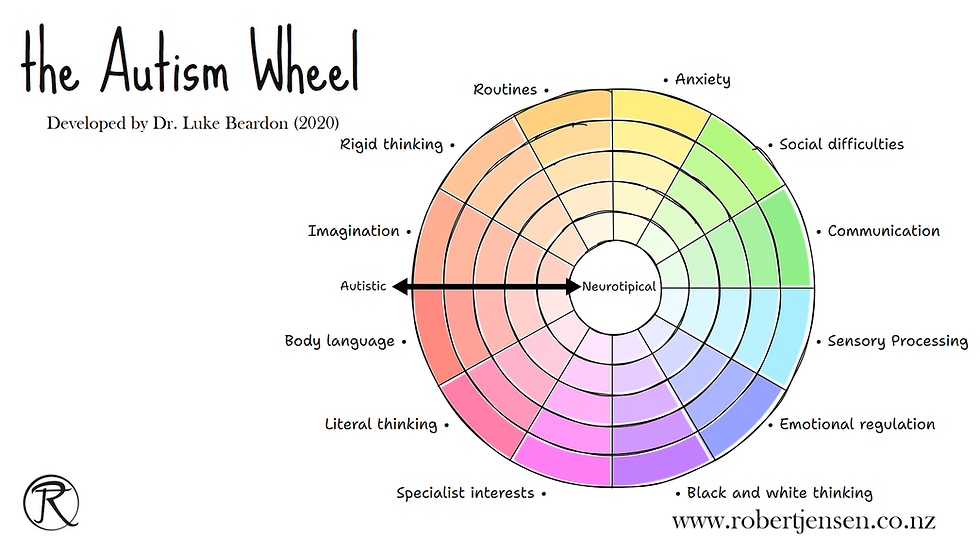
The Autism Wheel
The Autism Wheel not a diagnostic tool but a visual aid for identifying and understanding the intensity or impact of traits a neurodivergent person experiences in their life. The Autism Wheel is deeply personal and a visual way to reflect on neurodivergent traits or patterns of behaviour that may impacting on their life and relationships in both positive and negative ways. Understanding their skills, strengths and challenges provides a new perspective to understanding of the situations where they thrive, or the experiences that can trigger emotional or physical responses that have an impact on a neurodivergent person’s life. Because the Autism Wheel is personalised it explores the lived experience rather than using generic diagnostic labels, making it an inclusive way of understanding neurodivergent ways of being, doing and knowing. The Autism Wheel can also be adapted to include traits and behaviours of other types of neurodivergence like ADHD, like the Colour Me Neurospicy (2025) version for people with AuDHD.
Adapting the Autism Wheel to AuDHD people

Example of Autism Wheel, adapted from image by Róisín Kelly (2023)
Neurodivergent traits like special interests (autism) or hyper focus (ADHD) can be experienced as a strength or challenge depending on how they are expressed or impacted by outside environmental factors like sensory or social influences. Educators are not trained to, and should not attempt to, diagnose neurodivergent learners. Developing teaching strategies based on a learner’s diagnosis, limits educators’ abilities to support neurodivergent learners and their personal experience of neurodivergence.
Dr Luke Beardon
The earlier description of neurodivergence being ‘Genetics + Epigenetics/Environment = Neurodivergence’ is based on Dr Luke Beardon’s writing about anxiety and autism, where he shares his concept of ‘Autism + Environment = Outcome’ to explain differences in behaviour. The Autism Wheel gives educators a way of exploring patterns of behaviour that can be linked to environmental factors. For example, a neurodivergent learner with sensory processing issues who is in a noisy, brightly lit learning environment may become dysregulated, emotionally or physically, and then may cause disruptions in the classroom. Adjusting the noise levels and lighting in the learning environment will create a more positive learning environment and reduce the neurodivergent learner's disruptive behaviours.
Adapting for Neurodiversity in Education
When exploring neurodivergence in education, the Autism Wheel can be used as a teaching tool to understand relationship between neurodiverse traits or patterns of behaviour and the environmental factors in neurodivergent learners’ self-regulation. Whether discussing with parents or during conversations with learners, the Autism Wheel focuses on their personal lived experience. Focusing on a learners lived experience gives educators an opportunity to develop teaching strategies that support a learner’s ability to self-regulate their executive functions, emotions, and sensory and nervous system responses, with an understanding of how the learning environment can affect them and their learning.
Using the Autism Wheel model to discuss, plan and develop teaching strategies gives educators the ability to focus on a neurodivergent learners lived experience in a holistic and inclusive approach that honours their uniqueness rather than their ‘label’.

This Blog was written and illustrated by Coactive Education facilitator, Robert Jensen
With 18+ years in early childhood education, Robert is all about helping kids of all abilities shine. His background in event management and performing arts adds a creative spark to learning, making classrooms more engaging and inclusive.
As an Early Intervention Leader at Tui Early Learners, he works closely with teachers and parents to support neurodiverse children. He uses hands-on experience and proven strategies to build self-regulation, resilience, and confidence. His work earned him and Tui the Early Childhood Council Innovation Award and the Manawatū Inclusive Business Award in 2024.
Beyond the classroom, Robert supports head teachers and teaching teams and drives professional development. He is always looking for ways to make learning more accessible and fun. He believes every child deserves a learning environment that helps them thrive.
Passionate, practical, and always up for a challenge, Robert is dedicated to helping kids, families, and teachers grow together.
References and Acknowledgements
Banks, E. (2023, April 12). Why is Autism Considered a Spectrum? What it Actually Looks Like. Enna. https://enna.org/why-is-autism-considered-a-spectrum-what-it-actually-looks-like/
Beardon, L. (2020). AVOIDING ANXIETY IN AUTISTIC CHILDREN: a guide for autistic wellbeing. Sheldon Press.
Colour Me Neurospicy. (2025). Colour Your Own Spectrum (003 ed.). Colour Me Neurospicy. https://colourmeneurospicy.com.au/products/colour-your-own-spectrum-chart
Doyle, N. (2006). The Overlapping Skills and Strengths of Neurodiversity based on work by Mary Colley (National Library of Medicine, Ed.). https://www.nnlm.gov/reading-club/topic/331
Kelly, R. (2022). Autism wheel [Online Image]. In https://www.altogetherautism.org.nz/what-is-autism/. www.rkcreator.com


https://thoitiethomnay.org/ ừ thì đúng kiểu mở ra xem ké tí thôi mà lại đứng lại đọc thêm, vì nó show thẳng nhiệt độ hiện tại với “cảm giác như” ngay đầu nên khỏi phải kéo xuống tìm, mình nhớ lúc nãy thấy 30°C mà cảm giác như 33°C gì đó, nhìn phát là biết hôm nay oi cỡ nào. Xem nhanh được. Chọn tỉnh/thành cũng tiện. Mình hay đổi qua lại vài nơi nên thích kiểu bấm cái là ra số liệu liền. Với lại thấy họ cập nhật trong ngày nên lúc quay lại không bị “y chang hồi sáng”. Mấy khối thông tin tách rõ nên mắt đỡ mỏi. Nói chung dùng kiểu lướt lướt hợp. Cái ô…
tỷ lệ kèo nhà cái mình thấy bạn bè nói hoài nên cũng bấm vào xem thử cho biết. Vào trang cái là mình để ý ngay giao diện nhìn khá thoáng, không bị rối mắt kiểu chữ dày đặc. Nội dung họ chia thành từng khối rõ ràng nên mình lướt một vòng là biết chỗ nào đáng nhìn trước, khỏi phải dò từng dòng. Mình cũng thích mấy bảng số liệu trình bày theo cột gọn gàng, nhìn phát là bắt được ý, không cần kéo ngang qua lại. Menu thì đặt ngay chỗ dễ thấy, bấm qua lại mượt, không bị lạc. Nói chung mình chỉ xem nhanh thôi mà vẫn thấy dễ chịu vì các khối…