
3 Signs a Child May Be Struggling With Oral Language (And What Teachers Can Do About It)
Why Oral Language Matters
Long before children learn to read and write, they learn to communicate through oral language.

Oral language includes listening, understanding, vocabulary development, storytelling, conversation skills, and the ability to express ideas, thoughts, and feelings. These skills form the foundation for literacy, learning, relationships, and wellbeing.
Research consistently shows that oral language development is a strong predictor of later literacy achievement. A recent meta-analysis of 72 longitudinal studies involving more than 23,000 children found that preschool vocabulary and grammar significantly predicted later reading comprehension and word reading outcomes (Jago et al., 2025).
Children with strong oral language skills are more likely to develop reading comprehension successfully, while children with language weaknesses are at greater risk of later literacy difficulties (Lervåg et al., 2018).
The challenge for educators is that oral language difficulties are often less visible than reading or writing difficulties. Identifying concerns early can make a significant difference.
3 Signs a Child May Be Struggling With Oral Language (And What Teachers Can Do About It)
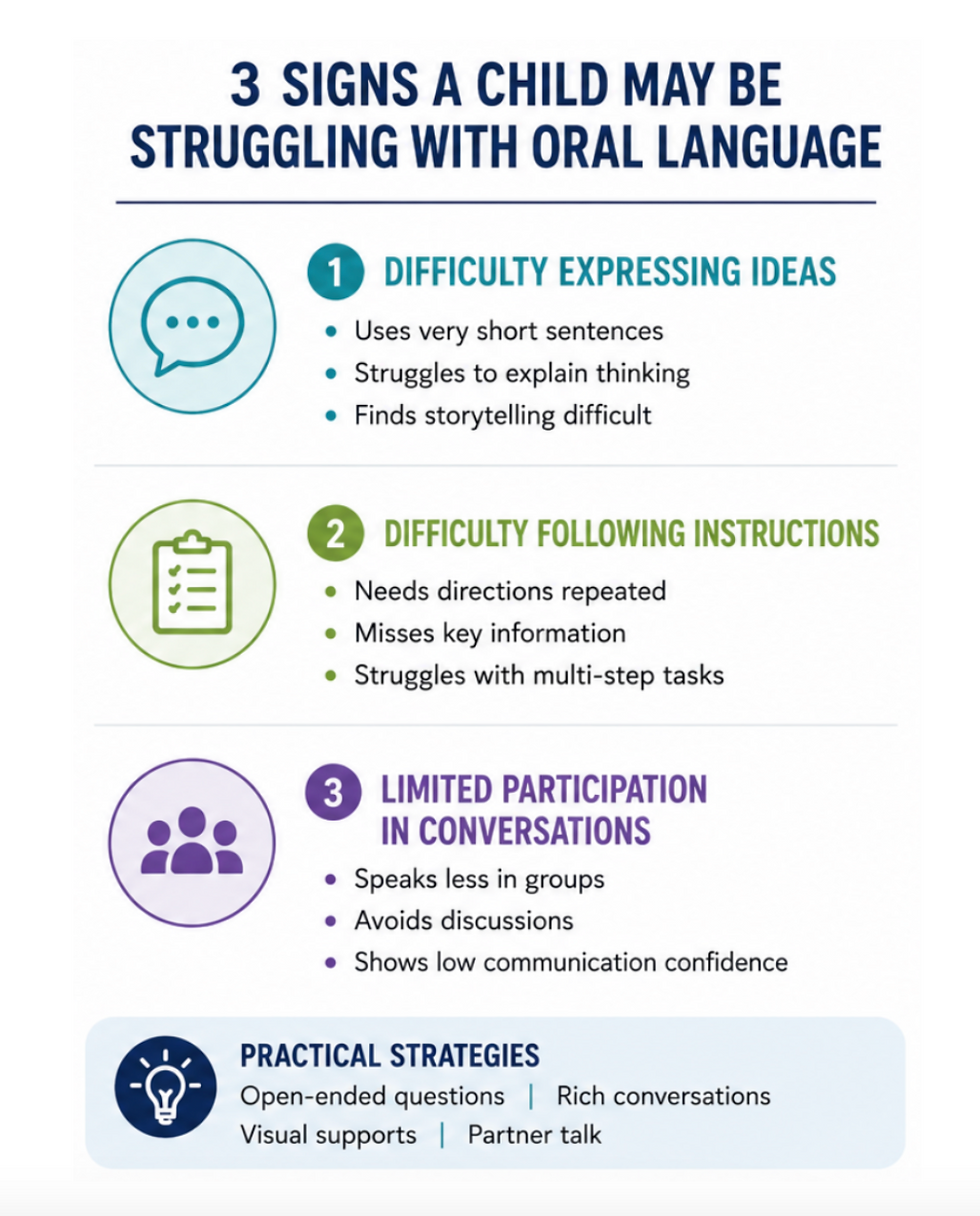
Sign 1: They Have Difficulty Expressing Their Ideas
Many children occasionally struggle to find the right words. However, persistent difficulty expressing thoughts, retelling events, explaining ideas, or participating in conversations may indicate an oral language challenge.
You may notice a child:
Using very short or simple sentences
Frequently responding with "I don't know"
Struggling to describe experiences
Finding it difficult to tell stories in sequence
Having trouble explaining their thinking
Children with expressive language difficulties often understand more than they can communicate.
What Educators Can Do
Research suggests that rich, responsive conversations are among the most effective ways to support language development.
Try:
Open-ended questioning
Shared storytelling
Dramatic and imaginative play
Small-group discussions
Explicit vocabulary teaching
Extending children's responses through sustained conversations
These approaches help expand vocabulary, sentence complexity, and confidence in communication.
Sign 2: They Struggle to Follow Instructions
A Child May Be Struggling With Oral Language if they find it hard to follow instructions. Oral language is not only about speaking. It also includes understanding and processing language.
Children experiencing receptive language difficulties may:
Need instructions repeated frequently
Miss key information during discussions
Appear disengaged or distracted
Struggle to follow multi-step instructions
Have difficulty understanding classroom routines
Sometimes these behaviours are mistaken for inattention when the underlying issue is language comprehension.
What Educators Can Do
Support comprehension by:
Breaking instructions into smaller steps
Using visual supports
Modelling tasks before expecting children to complete them
Checking for understanding
Providing additional processing time
Research shows that combining spoken language with visual and contextual support can improve understanding and participation for children experiencing language difficulties.
Sign 3: They Participate Less in Conversations
Children who struggle with oral language often participate less in classroom discussions, group learning experiences, and peer interactions.
You may notice:
Reluctance to contribute during mat time
Limited participation in group discussions
Avoidance of peer conversations
Reduced confidence when speaking
Minimal responses to questions
This can create a cycle where children have fewer opportunities to practise language, further limiting language growth.
What Educators Can Do
Create low-pressure opportunities for communication through:
Partner talk activities
Turn-taking games
Small-group conversations
Collaborative play experiences
Structured discussion prompts
Intentional language modelling
The goal is to build both language skills and communication confidence.
What Does the Research Say About Oral Language Intervention?
The encouraging news is that oral language can be improved through intentional teaching.
The Education Endowment Foundation's evidence review found that oral language interventions produce an average of six months' additional learning progress, with particularly strong effects in the early years and primary settings.
Research on the Nuffield Early Language Intervention (NELI) found that children receiving targeted language support made additional progress in oral language development compared with peers who did not receive the intervention. Follow-up studies also found gains in language and word reading outcomes.
Studies consistently show that supporting oral language development strengthens:
Vocabulary knowledge
Listening comprehension
Reading comprehension
Literacy development
Classroom participation
Academic achievement
Creating a Language-Rich Learning Environment
Supporting oral language development is not about adding one more programme to an already busy day.
It is about creating environments where meaningful talk happens frequently and intentionally.
Effective language-rich environments often include:
High-quality conversations
Shared book reading
Explicit vocabulary instruction
Rich storytelling opportunities
Responsive teacher-child interactions
Play-based learning experiences
Strong partnerships with whānau
Research suggests these everyday interactions can have a powerful cumulative impact on children's language and literacy development.
Why Early Identification Matters
Oral language difficulties rarely disappear on their own.
Research shows that early language skills are closely connected to later reading comprehension, learning, and educational success. Identifying concerns early allows educators to provide targeted support before difficulties become more significant barriers to learning.
For kaiako and teachers, recognising the signs is often the first step towards making a lasting difference.
Strengthening Oral Language Through Professional Learning
Supporting oral language development requires more than good intentions. It requires educators to understand how language develops, how to identify concerns early, and how to create environments that foster communication and learning.
Professional learning can help educators strengthen their understanding of:
Oral language development
Language-rich teaching practices
Assessment and observation
Literacy foundations
Evidence-informed interventions
Responsive teaching strategies
By strengthening educator capability, we create more opportunities for tamariki to develop the communication skills that underpin lifelong learning success.
Frequently Asked Questions About Oral Language
What is oral language?
Oral language refers to the ability to listen, understand, speak, communicate ideas, and engage in conversations with others.
What are signs of oral language difficulties?
Common signs include difficulty expressing ideas, difficulty following instructions, and limited participation in conversations.
Why is oral language important?
Oral language supports literacy development, reading comprehension, learning, social relationships, and wellbeing.
How can teachers support oral language development?
Teachers can support oral language through rich conversations, storytelling, explicit vocabulary instruction, shared reading, and language-rich learning environments.
References
Education Endowment Foundation. (2025). Communication and language approaches. https://educationendowmentfoundation.org.uk/early-years/toolkit/communication-and-language-approaches
Education Endowment Foundation. (2025). Oral language interventions. https://educationendowmentfoundation.org.uk/education-evidence/teaching-learning-toolkit/oral-language-interventions
Jago, L. S., Monaghan, P., Alcock, K., & Cain, K. (2025). The effect of preschool vocabulary and grammar on early reading comprehension and word reading: A systematic review and meta-analysis. Educational Research Review, 100680.
Lervåg, A., Hulme, C., & Melby-Lervåg, M. (2018). Unpicking the developmental relationship between oral language skills and reading comprehension: It's simple, but complex. Child Development, 89(5), 1821–1838.
Nuffield Early Language Intervention. (2025). Evidence and development. https://www.teachneli.org/intervention/evidence-and-development/


Comments