
Intentional Teaching in Early Childhood Education: Rethinking Our Role in Play

Is Play Really Child-Led? Challenging a Common ECE Belief
Play has become one of the most protected ideas in early childhood education. We talk about it as sacred—child-led, free, untouched by adult interference. And don’t get me wrong, those things matter. They sit at the heart of what we do. But I think somewhere along the way, in trying to protect play, we’ve misunderstood our place within it.
Because what I see more and more in practice is this shift toward stepping back.
Beautiful environments are set up and thoughtful provocations are offered. Children are deeply engaged and teachers… watch, wait and hold back. Not because they don’t care—but because they do. Because they’ve absorbed the message that being intentional might mean interfering, and that stepping in could disrupt something important.
There’s this overriding perspective that given the time and space, children will lead their own learning. And sometimes that’s true. But sometimes it’s not.
And sometimes, children aren’t asking to be left alone at all.

When Stepping Back Goes Too Far in Early Learning Settings
In many early learning environments, “stepping back” has become the default. It feels safe. It aligns with play-based philosophy. But when taken too far, it can create distance between teacher and child.
Observation is important—but observation alone is not intentional teaching.
Children don’t just need space. They need connection. They need attuned adults who notice, interpret, and respond in meaningful ways. When we step back without stepping in when needed, we risk missing what children are actually communicating through their play.
Understanding Play as Communication in Early Childhood (Play Therapy Insights)
What Play Therapy Taught Me About Children’s Behaviour
When I trained with ChildPlayWorks and completed their introduction to play therapy course, it didn’t just add to my practice—it challenged everything I thought I knew about play and forced me to look again.
Because in the child-centred world of play therapy, play isn’t just exploration. It’s fundamentally communication.
Why Play Is a Language for Children
Play is how children process their experiences. It’s how they make sense of emotions they don’t yet have words for. It’s how they test ideas about power, relationships, safety, and belonging in a safe and therapeutic way.
Play becomes a language—one that is rich, layered, and deeply personal.
And once you begin to see play this way, it completely changes how you respond to it.
Because if play is language, then our role can’t just be to observe it.
As professionals privileged with the role of spending time with children, we are part of the conversation.
What Intentional Teaching Really Looks Like in Practice
Moving From Planning to Presence
That realisation shifted something fundamental in me. I stopped asking, “What should I plan to respond to this child’s learning?” and started asking, “What is this child trying to tell me?”
It sounds simple, but it changes everything.
The Role of the Teacher in Child-Led Play
Intentional teaching stops being about what we set up and starts being about how we show up. It lives in the moment—in the noticing, the interpreting, and the response.
Not in directing play, but in entering it carefully.

Not in controlling outcomes, but in deepening experience.
Supporting children to learn isn’t about what resources we put on the tables—it’s about what we do, say, and how we are with the children who are engaged with them.
A Real Example: Understanding Behaviour Through Play

I remember one child who made this shift undeniable for me.
Day after day, they would knock over anything another child built. Every structure, every creation, every time.
The responses were predictable—reminders about kind hands, encouragement to build instead, gentle redirection.
But nothing changed.
Because we were responding to the behaviour—not the message underneath it.
Looking Beyond Behaviour to the Underlying Need
So I watched more closely and began joining the play rather than trying to redirect it.
And slowly, the pattern started to make sense.
The behaviour wasn’t about upsetting others—it was about control. About power. About a child needing to feel big in a world where they often felt small.
So we built things together.
And we knocked them down together.
We named the feeling of being strong, of having impact.
At the same time, we held clear boundaries when other children were involved.
And over time, things shifted.
Not because we stopped the behaviour—but because we understood it.
Finding the Balance: Guidance vs Observation in ECE
This is where I think we need to be more honest as a profession.
We’ve done important work moving away from overly structured, adult-directed teaching. But in doing so, we’ve sometimes lost clarity around what intentional teaching actually is.
Because it’s not controlling play or directing outcomes. But it’s also not standing back indefinitely or confusing observation with intention.
It sits somewhere in-between.
Why Observation Alone Isn’t Enough
Intentional teaching lives in the quiet, relational work of:
Sitting beside a child in their hardest moments
Entering play without taking it over
Naming what you see
Interpreting how they feel
Holding boundaries with calm, attuned presence
It’s subtle. It requires skill. But it’s where the real impact lies.
Supporting Teachers in Aotearoa New Zealand’s ECE Context
Over time, I started to notice that this wasn’t just a personal shift—it was something many teachers were grappling with.
Especially beginning teachers, or those coming into Aotearoa from other systems, where expectations around teaching can look very different.
Bridging Theory and Practice in Te Whāriki and ECE Frameworks
We have some of the most powerful guiding documents in the ECE sector:
Te Whāriki
He Māpuna te Tamaiti
Kōwhiti Whakapae
Talking Together – Te Kōrerorero
They speak deeply to this relational, responsive way of teaching.
But they’re not always easy to translate into what you actually do in the moment.
So many teachers default to what feels safe: set up the environment, step back, observe—and hope that’s enough.
The Intentional Practice Reference Guide: Making ECE Frameworks Usable
That’s why I created the Intentional Practice Reference Guide through HeartLead NZ.
Not as something new—but as a bridge.
A way to make those documents more visible, more usable, more connected to real practice.
A way to help teachers see what intentional teaching actually looks like—across different areas of learning, in real moments, with real children.
Because the guidance is already there.We just need to bring it closer to the floor.
The Impact of Intentional Teaching on Children’s Development
The more I’ve worked in this space, the more I’ve come to sit with this deeper truth:
We hold an extraordinary amount of influence as early childhood teachers.
Not just in what children experience and learn—but in how they come to see themselves.
Whether they feel safe
How they understand their emotions
What they come to expect from relationships
That kind of influence can’t be ignored.
Why Intentional Teaching Deepens Play, Not Disrupts It
We need to be present.
We need to be responsive.
We need to be willing to step into the complexity of children’s play rather than watching it from a distance.
Maybe it’s time we loosen our grip on the idea that stepping back is always best.
Maybe we start to see intentional teaching not as interference—but as connection.
Because when we show up—thoughtfully, respectfully, relationally—play doesn’t lose its power- It deepens. And children don’t just experience freedom—they experience being seen.
Final Reflection: The Responsibility of Being Invited Into Children’s Play
Play therapy didn’t just give me a new theory or set of strategies.
It gave me a different perspective—one that I now can’t unlearn.
A reminder that when children invite us into their play, they are inviting us into their inner world.
And that’s not something to take lightly.
It’s something to embrace—with care, with intention, and with respect.
Because this work isn’t just about facilitating learning through play— it’s about what we choose to do with the trust children place in us.

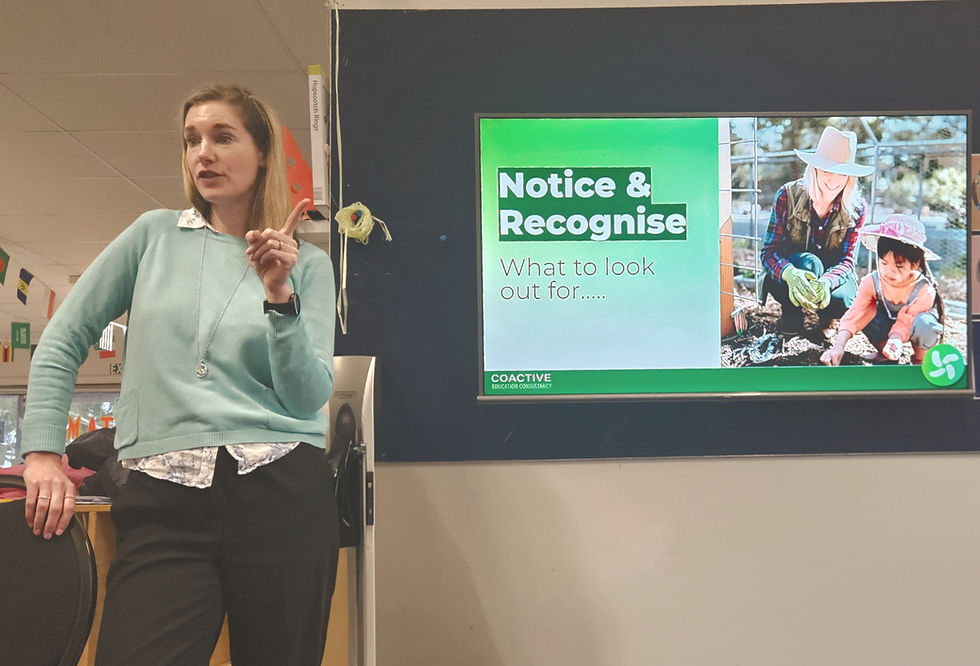
This Blog was written by Coactive Education Facilitator Gabby Dyet.
As an experienced ECE leader and facilitator with over a decade across private, corporate, and home-based services, I have held a range of leadership roles that have strengthened my expertise in governance, management, and curriculum. I bring a strong background in aligning systems and processes to create effective, streamlined quality improvement for services. As a passionate play advocate, I bring expertise in therapeutic teaching techniques, meaningful curriculum planning and assessment, and responsive intentional teaching practices. I support services with all aspects of leadership to build and sustain high-performing teams where both kaiako and tamariki capability and confidence can thrive.


Comments